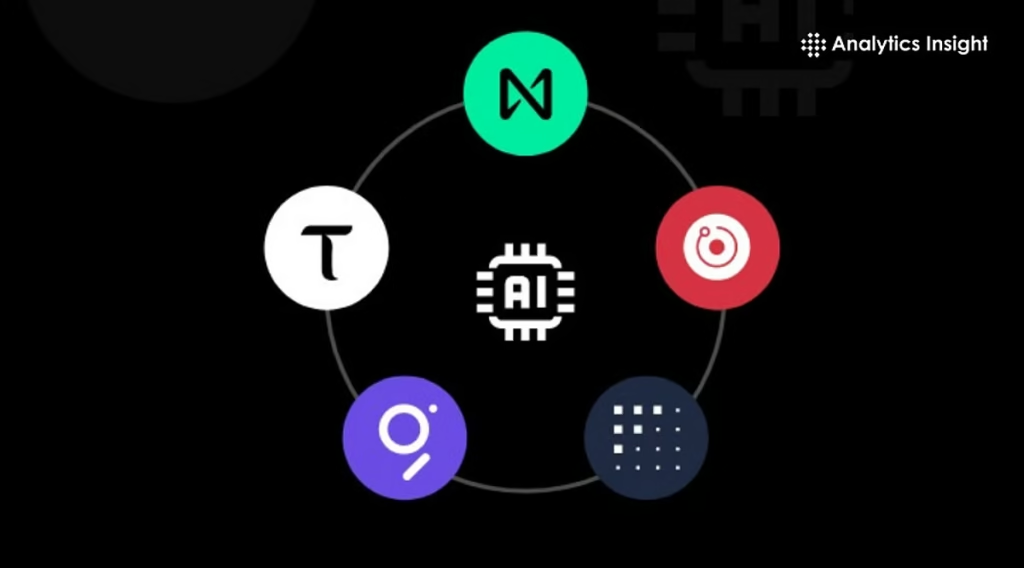
In 2026, the convergence of artificial intelligence (AI) and cryptocurrency has evolved from a niche hype cycle into a mature ecosystem driving real-world innovation. With global AI adoption accelerating—projected to contribute $15.7 trillion to the economy by 2030 according to PwC—the blockchain sector has become a critical infrastructure for decentralized AI applications. AI cryptocurrencies, or “AI coins,” are no longer just speculative assets; they power everything from decentralized machine learning networks to GPU rendering marketplaces and data oracles. This shift is fueled by advancements in decentralized physical infrastructure networks (DePIN), autonomous agents, and on-chain AI inference, making 2026 a pivotal year for investors seeking high-growth opportunities.
As of March 2026, the AI crypto market cap has surpassed $50 billion, with leading projects demonstrating robust developer activity, institutional backing, and tangible utility. Factors like regulatory clarity in the U.S., integration with major blockchains (e.g., Ethereum and Solana), and partnerships with tech giants have propelled this growth. However, volatility remains high, with the sector experiencing a 25% average drawdown in Q1 2026 amid broader market corrections.
In this detailed article, we’ll explore the top AI cryptocurrencies for 2026, ranked by a combination of market capitalization, technological innovation, network activity (e.g., daily GitHub commits), and growth potential. We’ll delve into each project’s core technology, use cases, performance metrics, risks, and price forecasts based on analyst predictions. Whether you’re a seasoned investor or new to crypto, this guide will help you navigate the best AI coins poised for explosive growth. Note: All prices and market caps are approximate as of mid-March 2026 and subject to market fluctuations.
1. Bittensor (TAO): The Decentralized Machine Learning Powerhouse
Bittensor stands out as the undisputed leader in AI crypto for 2026, often dubbed the “decentralized collective brain.” Launched in 2021, Bittensor creates an open-source marketplace where AI models compete and collaborate through a proof-of-intelligence consensus mechanism. Miners (validators) contribute computational resources to train and refine machine learning models, earning TAO tokens as rewards. This incentivizes high-quality AI outputs, addressing centralized AI’s issues like data silos and bias.
Key Features and Use Cases:
- Decentralized Training: Over 1,000 nodes actively train models for applications like natural language processing and predictive analytics.
- Ecosystem Growth: Integrations with Web3 tools enable AI-driven DeFi strategies and NFT generation.
- Developer Activity: Bittensor leads with an average of 150+ daily GitHub commits, surpassing competitors like NEAR.
2026 Performance and Outlook: With a market cap of around $3.44 billion and a current price of approximately $390, TAO has seen a 41.5% increase in the last 30 days. Analysts predict TAO could reach $800–$1,200 by year-end 2026, driven by partnerships with hyperscalers like Google Cloud for hybrid AI-blockchain solutions. Risks include competition from centralized AI giants and potential regulatory scrutiny on energy-intensive mining.
2. NEAR Protocol (NEAR): Scalable Infrastructure for AI Apps
NEAR Protocol is a layer-1 blockchain optimized for AI, offering sharding technology for high throughput (up to 100,000 TPS). It’s designed for user-friendly development, making it ideal for AI dApps like autonomous agents and smart contracts that incorporate machine learning.
Key Features and Use Cases:
- Nightshade Sharding: Enables parallel processing for AI workloads, reducing costs compared to Ethereum.
- AI-Native Tools: Supports projects like NEAR AI, which integrates on-chain inference for real-time predictions.
- Ecosystem: Over 500 dApps, including AI-powered gaming and supply chain optimization.
2026 Performance and Outlook: Priced at about $1.32 with a $1.75 billion market cap, NEAR has grown 12.4% year-to-date. Forecasts suggest a rise to $5–$8 by late 2026, bolstered by its role in agent-to-agent commerce. Risks: High competition from Solana and potential scalability bottlenecks during AI hype cycles.
3. Render Network (RENDER): GPU Marketplace for AI Rendering
Render Network decentralizes GPU computing, allowing users to rent idle graphics cards for AI tasks like 3D rendering and model training. It’s essential for generative AI, powering tools in metaverses and video production.
Key Features and Use Cases:
- DePIN Model: Over 10,000 GPUs in the network, reducing costs by 90% vs. cloud providers like AWS.
- OctaneRender Integration: Supports Hollywood-level graphics, with partnerships in gaming (e.g., Unreal Engine).
- AI Expansion: New features for AI video generation and deep learning simulations.
2026 Performance and Outlook: At $1.75 per token and a market cap exceeding $1 billion, RENDER has stabilized after a volatile 2025. Experts anticipate 200%+ growth to $4–$6, fueled by the AI art boom. Risks: Dependency on GPU hardware prices and competition from Akash Network.
4. Artificial Superintelligence Alliance (FET): The Merged AI Giant
Formed from the merger of Fetch.ai, SingularityNET, and Ocean Protocol, ASI (traded as FET) creates enterprise-grade AI infrastructure for autonomous agents. It focuses on data marketplaces and AI automation.
Key Features and Use Cases:
- Autonomous Agents: FET powers bots for supply chain and finance automation.
- Data Monetization: Ocean’s data oceans enable secure AI training datasets.
- SingularityNET Marketplace: Over 1,000 AI services listed for developers.
2026 Performance and Outlook: With a $3+ billion market cap, FET trades at around $1.50, up 160% from lows. Projections: $3–$5 by end-2026, with merger synergies unlocking value. Risks: Integration challenges post-merger and regulatory issues on data privacy.
5. Internet Computer (ICP): On-Chain AI Compute
ICP provides sovereign cloud hosting for AI apps, running everything on-chain without centralized servers.
Key Features and Use Cases:
- Canister Smart Contracts: Host AI models directly on blockchain for tamper-proof execution.
- High Activity: 200+ daily commits, focusing on AI sovereignty.
- Applications: Decentralized social media with AI moderation.
2026 Performance and Outlook: Priced at $2.63 (market cap $1.46 billion), ICP could hit $10+ with AI adoption. Risks: Complex tech stack may hinder mass adoption.
6. Chainlink (LINK): AI Data Oracles
Chainlink supplies secure data feeds for AI models, bridging blockchain and external datasets.
Key Features and Use Cases:
- Decentralized Oracles: 211+ daily commits for AI integrations.
- CCIP: Cross-chain interoperability for AI ecosystems.
2026 Performance and Outlook: $9.26 billion market cap; potential to $20–$30. Risks: Oracle centralization concerns.
7. Filecoin (FIL): Decentralized Storage for AI Data
Filecoin leads in DePIN storage, crucial for AI datasets.
Key Features: 349+ daily commits; petabytes of storage.
Outlook: Market cap $5+ billion; growth to $15–$20/token.
8. The Graph (GRT): AI Data Indexing
GRT indexes blockchain data for AI queries.
Outlook: Strong in DeFi-AI hybrids.
9. Virtuals Protocol (VIRTUAL): Emerging AI Agent Economy
New entrant for AI agents; 220% 30-day gain.
Outlook: High-risk, high-reward.
10. Grass: DePIN Data Scraping
Grass monetizes unused bandwidth for AI data collection.
Outlook: Poised for growth in agentic AI.
Market Trends and Risks in 2026
The AI crypto sector is projected to grow 300% by 2027, driven by autonomous payments (x402 standard reaching 30% of Base transactions). However, risks include regulatory crackdowns, energy consumption debates, and hype-driven bubbles. Investors should diversify, use exchanges like Binance or Coinbase, and focus on projects with proven utility.
Conclusion
2026 marks the maturation of AI crypto, with Bittensor, NEAR, and Render leading the charge. These projects offer massive potential but require due diligence. As AI reshapes industries, these coins could deliver 5x–10x returns for early adopters. Stay informed, invest wisely, and watch for updates in this dynamic space.